Tuesday, October 11, 2016

Obscured by Clouds

Climate Geoengineering Part 3 of 4
This short series of posts addresses climate geoengineering: "the deliberate large-scale intervention in the Earth’s natural systems to counteract climate change." My aim is to answer the following questions:
  1. Prometheus or Icarus? - Why consider climate geoengineering at all?
  2. Fire and Ice - A synthetic sulphuric aerosol veil in the stratosphere?
  3. Obscured by Clouds - What other geoengineering options are feasible?
  4. Kintsugi and the Moral Hazard - What would Jesus do?

A summary of the first two parts of this series on geoengineering:
  • Human-caused climate change is real and building momentum.
  • Transitioning from our current fossil fuel economy to a renewable energy economy is a beast to tackle, even if we didn't complicate it with fossil fuel-funded political denial.
  • The world's carbon cycle had been balanced for at least 800,000 years.
  • Fossil fuels are stored carbon from before the dinosaurs, and industrialized economies since the 1750s have been putting that stored carbon into the atmosphere.
  • The excess carbon in the atmosphere (carbon dioxide, CO2) traps the sun's energy, warming the planet. A degree of warming is great, preventing a snowball Earth, but now we're heating the place up with additional trapped warmth. 
  • Sulfur dioxide in the high atmosphere (stratosphere) causes a cooling effect on the planet, since it blocks some of the sun's energy from ever making it in to get trapped by CO2.
  • One of the main ideas for geoengineering the climate is to intentionally deliver sulfur to the upper atmosphere to block some of the sun's energy.

This post is broken into 4 parts:
  1. Carbon Storage - Direct Air and Power Plant Exhaust
  2. Carbon Storage - Ocean Fertilization
  3. Carbon Storage - Afforestation
  4. Cloud Whitening

Carbon Storage - Direct Air Capture and Power Plant Exhaust

"That negative [CO2] emission are likely to be necessary if the chances of two degrees of warming are to be kept low surprises many people. There is a widespread belief that simply stabilizing emissions - emitting the same amount each year - solves the warming problem."
- Oliver Morton, The Planet Remade

The problem is that we've got too much CO2 in the atmosphere due to the burning of fossil fuels. There are other greenhouse gases that we pollute the atmosphere with as well (like methane and nitrous oxide), but CO2 stays up there by far the longest and is much more prevalent. One of the most obvious questions to ask, then, is why don't we just remove the excess CO2 from the atmosphere?


To get a sense of the challenge, let's consider a quarter teaspoon of salt like in the image above. A quarter teaspoon of salt has about 10,000 grains of salt in it. If we let that spoon represent 10,000 molecules of our atmosphere, just 4 grains of salt in that spoon make up the portion of our atmosphere that's CO2. In other words, the challenge of removing CO2 from the atmosphere is the challenge of finding and filtering out four particular grains of salt from a quarter teaspoon.

The most obvious place to do this filtering is at the source: power plant flues. Approximately 10%-25% of the exhaust from fossil fuel power plants is CO2 (Source). This technology, known as Carbon Capture and Storing increases the cost per watt of electricity generated by at least 20% and as high as 90%. This cost is likely to change, however, given the implementation of carbon taxes and the costs expected due to mitigating the effects of climate change (Source).
"The only way to understand CCS is to actually do it. We cannot do without this, in my view. We're looking for really positive and quick action... Deployment is what we're talking about. Not research." (Source.)

Three problems with carbon capture technology:
  1. Once the carbon is captured, where should it be stored? The likely place is injection into geological formations as in the use of advanced oil/natural gas recovery techniques, like fracking. In 1986 a landslide in Cameroon released a cloud of CO2 that suffocated 1,700 people (Source).
  2. It costs a lot to implement, especially when retrofitted to existing power plants. Furthermore, power plants that use this technology use about 40% more energy to run (Source).
  3. It isn't effective enough. It may remove up to 90% of CO2 in power plant exhaust compared to standard power plants, but we've got to decrease the CO2 in the atmosphere, not just minimize what we're putting up. We don't have the technology for that yet.
This article is an overview of the "world's first power plant with negative emissions", fueled by biomass cut from forests. The diagram below illustrates the process.


Carbon Storage - Ocean Fertilization

The ocean holds about 50 times the amount of carbon as the atmosphere. Carbon capture and storage in the ocean seeks to increase the amount of carbon the ocean can store, and this would aid in removing more CO2 from the atmosphere.

There are large patches of the ocean rich in the ingredients for life except for a deficiency in iron. By providing those areas with iron we could increase the amount of organisms (phytoplankton) present that could feed themselves on the CO2 in the ocean; the more ocean CO2 they remove, the more CO2 the ocean can absorb from the atmosphere.


What the diagram above illustrates is that by fertilizing parts of the ocean with iron we'd be promoting the growth of ocean plants that then get eaten by ocean creatures (zooplankton). The carbon in the plants and creatures would eventually fall to the floor of the ocean where it would get stored for a while (estimates of 100 years), though not permanently (Source).

One of the amazing things about this idea is how effective it could be. It's estimated that 10 grams of iron could fix 2,200 pounds (1 tonne) of carbon (a factor of 100,000 to one). In other words, less than .05% of all iron mined might be enough to completely offset human carbon emissions (Source).


The image above highlights the concerns with ocean fertilization:
  1. How much carbon will actually be removed from the atmosphere, and for how long? We know that this isn't a permanent storage of CO2, but just how long isn't clear.
  2. How much methane and nitrous oxide will be emitted? Both gases are much stronger greenhouse gases than CO2.
  3. What impact on ocean acidification will the added carbon have on the ocean? Remember from part 2 of this series that the oceans will not become acid, but they are already becoming more acidic than much ocean life can handle.
Some experiments were performed in the Southern Ocean and off the west coast of Canada, but the results weren't encouraging: the plankton that benefited most weren't the best suited to getting CO2 into the ocean's depths, and more nitrous oxide was produced than expected (Source). This article is a great overview of the 2012 Canadian experiment, and it also underlines the rogue nature that some groups may in the future adopt as climate change hits the fan.

So as we see again, our mathematical models are good, but Earth's systems are so complex that more experimentation is needed with this idea (and all geoengineering ideas) before we have a complete understanding.


Carbon Storage - Afforestation

"No matter how important forest conservation and reforestation efforts are for many economic, social, and biodiversity reasons, forestry can only be a piece in the large jigsaw puzzle that is (or would be) successful climate change mitigation."
- Climatologist Mark Trexler, Source 

Plants feed on CO2, so planting trees (afforestation - converting land into forests) falls on the list of climate change mitigation strategies.

It has been estimated that in order to remove the amount of industrial CO2 added to the atmosphere at year 2000 levels would take the planting of global forests equivalent to an area twice the size of India. This is an area of land also equivalent to half of the planet's current arable, or farmable, land (Source). China, where just 2% of original forests are intact, currently operates the world's largest afforestation project: 1.5% the area of India each year, with 85% of planted trees not surviving (Source).


Some challenges with this idea as a major climate change mitigation strategy:
  1. Despite progress in fighting deforestation (the global annual rate of deforestation has diminished by 50% since early 1990s), Earth's forests are still shrinking by close to 1 out of every 1000 acres per year (.08%). Forests still shrink due to human population expansion and agricultural uses. (Source.)
  2. Planting trees in snowy areas could increase the heat absorption of these areas, canceling the cooling effect of planting them. (And we should still plant them.)
  3. The carbon taken out of the atmosphere by new trees doesn't just remove it from the atmosphere; the newly available space left by the removed atmospheric carbon is partly taken up by some CO2 that the ocean will put back up.

Cloud Whitening

"Brightening things to cool them down is something you can do on scales from that of an individual house to a lake to a sea, using everything from micro-sprayed cloud-condensation nuclei to plain old paint."
- Oliver Morton, The Planet Remade 
After mopping our kitchen floor I like to put a fan to work blowing across the floor surface; this leads to the floor drying much more quickly than without the fan. There's always a layer of water vapor on the surface of water bodies. When I turn the fan on, it blows this water vapor away, and more of the water on the floor is able to evaporate. (Source.)

As water evaporates from large water bodies, it condenses at high elevations due to cooler air. Small particles of dust and pollen in the air make it much easier for the water vapor to condense into water droplets and then clouds. (Source.) Adding new particles into a cloud encourages additional condensation. 

This is the basic principle behind cloud seeding, one method of which was developed by an atmospheric scientist named Bernie Vonnegut (Kurt was given the idea for Ice-nine in Cat's Cradle, one of my favorite books, by H.G. Wells during a visit to his brother's lab).

Cloud seeding sees use around the world, most notably in China. In 2008 China seeded clouds prior to the Olympics to clear the air in Beijing, and they seeded during the Olympics to cause the clouds to rain prior to reaching Beijing and the opening/closing ceremonies. China has also used seeding in response to droughts, intentionally causing rain and snow. However, "there is still no convincing scientific proof of the efficacy of intentional weather modification as it only has 30 percent or less chance of success." (Source.)

While cloud seeding for cloud formation, saturation, and eventual rain or snow uses Vonnegut's silver iodide as particles, cloudships like the ones pictured below would form a fog-like cloud using vapor and salt from the ocean. (Source.)
It's a fairly straightforward process to increase cloud coverage, and since clouds reflect sunlight before it gets to the lower atmosphere, it's a fairly straightforward approach to keeping global warming at a minimum. In fact, some models suggest that cloud whitening "could produce enough cooling to more or less offset a doubling of carbon dioxide" in the atmosphere. Furthermore, if the process were turned off after having been started, the clouds would return to normal within a couple days at most (Source).

Issues with cloud whitening:
  • Surprise surprise, the biggest issue is a lack of funding for research! More research needs to be done to understand cloud formation and weather and atmospheric processes, but mostly money is needed to fund the prototype project developed by some Silicon Valley engineers. 
  • More white will reflect more light (as do 'natural' clouds and snow/ice), but water vapor is a more effective greenhouse gas than CO2. More water vapor in the air, if not reflecting the sun's energy, will trap it.
  • We don't know what the weather effects will be. Some models show large impacts on the Indian Monsoon and the Sahel in Africa. 

“Clouds have one of the biggest impacts on global temperature. But they’re one of the most poorly understood parts of the atmospheric system. There’s never been a way to do a controlled study of aerosols and clouds. Their interaction is a big mystery.”
Kelly Wanser, Silicon Valley entrepreneur, inventor, technologist


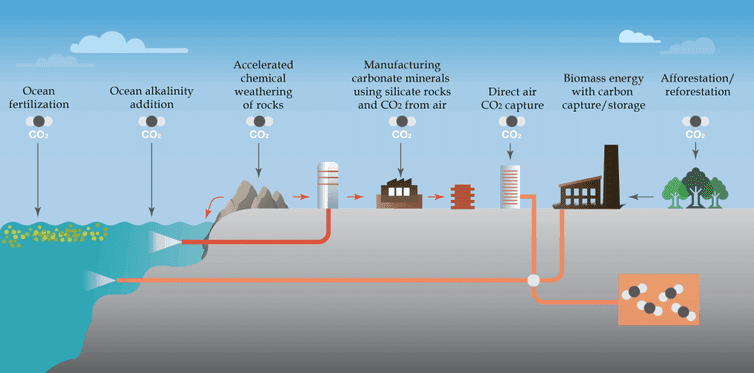
The two diagrams below summarize the major geoengineering options:


Thank you for reading.

- Check back in a week or so for Part 4 of this series!

"According to two ice-core records from Antarctica, the atmospheric carbon-dioxide level dropped by as much as 8ppm [3.2%] over the second half of the 16th century... When Europeans arrived in the Americas at the end of the 15th century, they brought with them diseases to which Native Americans had no immunity... [that] reduced the population of the Americas over the subsequent decades by 90% - from around 60 million to around 6 million...As a result, some half a million square kilometers which had been under cultivation reverted to scrub and forest, which would have sucked billions of tonnes of carbon out of the atmosphere... [It] is a good bet that at least some of the reduction of the CO2 level seen in the Antarctic ice is a result of all that plant growth."
- Oliver Morton, The Planet Remade


    Please comment if you have a response to this or any of my posts. I'd love to hear from you.


    Saturday, October 1, 2016

    Fire and Ice

    Climate Geoengineering Part 2 of 4
    This short series of posts addresses climate geoengineering: "the deliberate large-scale intervention in the Earth’s natural systems to counteract climate change." My aim is to answer the following questions:
    1. Prometheus or Icarus? - Why consider climate geoengineering at all?
    2. Fire and Ice - A synthetic sulphuric aerosol veil in the stratosphere?
    3. Obscured by Clouds - What other options are on the horizon?
    4. Kintsugi and the Moral Hazard - What would Jesus do?

    This page on wikipedia does an awesome job laying out the ideas, methods, and issues with adding sulfur to the upper atmosphere to block some of the sun's energy from ever entering. In this post I've added a further background structure with the hope that the necessary details and logic are clear, straight-forward, informative, and worth the read.

    This post is broken into 6 parts:
    1. The carbon cycle
    2. Where fossil fuels come from
    3. Where fossil fuel CO2 goes
    4. The greenhouse effect
    5. Atmospheric sulfur
    6. A veil to dim the sun

    The Carbon Cycle


    Before the industrial revolution, the global carbon cycle was well balanced for at least the past 800,000 years. In other words, any carbon added to the atmosphere through breathing or burning was soaked back up by either plant life or the ocean itself.

    Carbon leaves the atmosphere in 2 main ways:
    1. Photosynthesis by plants. Plants breathe in carbon dioxide, take the carbon atom and fix it as carbohydrates (energy) or to their bodies as new plant matter. They then breathe out the leftover oxygen. 
    2. Dissolving in sea water. Besides being used in photosynthesis by phytoplankton in the sunlit surface waters of the ocean, some ocean organisms use carbon to make their shells and skeletons or the carbon dioxide is stored as minerals through other chemical processes.
    As the diagram above shows, the carbon dioxide put into the atmosphere by natural causes is balanced by the carbon dioxide that gets removed from the atmosphere by natural causes.

    However, humans have been adding more CO2 to the atmosphere than Earth has been able to properly balance. The imbalance started with the industrial revolution. We'll be talking more about the imbalance briefly. (Source.)

    Where Fossil Fuels Come From

    Well before dinosaurs walked on Earth, many plants and animals that died didn't decompose completely before getting trapped within a swamp (Earth was pretty swampy then). Eventually, the plant and animal life turned into the fossil fuels we use today.

    When we burn fossil fuels, we're actually releasing the carbon dioxide that those plants breathed up and stored within their bodies and the bodies of the animals that ate them. Each time we burn fossil fuel we're releasing carbon that was stored deep underground for the last 300 million years or so. This added CO2 disrupts the natural balance that the carbon cycle has found over the last hundreds of thousands of years. (Source.)


    Where Fossil Fuel CO2 Goes

    Land plants are capable of absorbing about 25% of the extra CO2 that humans add to the atmosphere. They actually kind of like that extra CO2; it makes them run more efficiently. Another 25% is absorbed by the oceans; this CO2 is mostly dissolved, and it makes the oceans more acidic (the oceans won't become an acid, but they move toward the acid side of the pH spectrum and it endangers crustaceans and coral). NOTE: the oceans are capable of absorbing less and less fossil fuel CO2.

    The remaining 50% of fossil fuel CO2 stays in the atmosphere. We've increased the amount of atmospheric CO2 by about 43% since 1750. (Source.)


    The Greenhouse Effect

    "During the Middle Miocene, when temperatures were ~3° to 6°C warmer and sea level was 25 to 40 meters higher than at present, CO2 appears to have been similar to modern levels." - Science 

    If it weren't for the greenhouse effect, Earth might look something like this, a giant snowball of a planet:

    Energy from the sun enters our atmosphere and heats up the surface of the planet a bit. Some of that heat gets radiated back into space, and some gets absorbed by greenhouse gases (like CO2) in our atmosphere. This absorbed heat is what gives Earth a habitable climate, but excess greenhouse gases are now giving us excess heat. Check out the image below. (Source.)


    Here's a pretty common graph showing the relationship between temperature and atmospheric CO2 over the last 800,000 years (click to enlarge):

    Atmospheric Sulfur

    Some small molecules in our atmosphere absorb the sun's energy (like greenhouse gases). Others, such as small sulfur particles, reflect the sun's energy before it gets trapped in our atmosphere.

    Sulfur is an essential element for life. It makes it into our upper atmosphere naturally from volcanoes erupting, and ocean plant life put some up there too. Since sulfur particles reflect some of the sunlight that hits them, particularly powerful volcanoes sometimes have a short-lived measurable cooling effect on Earth's climate. (Source.)

    An industrial source of sulfur particles is the burning of fossil fuels, particularly coal. Because of the sulfur particles from coal power plants, it's actually possible that half of the warming due to CO2 in the atmosphere is actually being prevented due to our fossil fuel use. Whoa - so the Earth would actually be warming faster without the sulfur leaving smokestacks.

    In fact, if we stopped using all fossil fuels tomorrow, we'd likely see a sharp upward spike in temperature in the near future because the sulfur we put into the sky with the CO2 wouldn't be there, but the CO2 still would be - sulfur particles fall down much sooner than the CO2 would (by at least 90 years), and more heat would be let in and then trapped. (Source.)

    This is also why we saw a brief lull in temperature increases in the early 2000s; this lull is expected when we factor in China's growing industry's sulfur impacts on the atmosphere (Source).

    Don't get me wrong, this isn't an endorsement to keep burning coal to keep out the some of the sun's energy. The CO2 we are putting into the atmosphere is way worse than the "cooling" benefit we get from the concomitant sulfur particles.


    A Veil to Dim the Sun

    So, on to the main event. Basically, one of the leading ideas for dealing with the warming of the planet due to human-produced CO2 is to intentionally add sulfur molecules to the upper atmosphere. This "veil" in Earth's stratosphere would reflect some of the sun's energy before it entered Earth's atmosphere, thereby "cooling" Earth by preventing some of the sun's heat from getting to it in the first place.

    How we could get the sulfur up there:
    • Airplanes, civilian and/or military.
    • Modified artillery (large guns).
    • High-altitude balloons.


    Likely side-effects:
    • Ozone depletion. The sulfur dioxide we put up there will interact with the ozone layer.
    • Whitening or yellowing of the sky. The sulfur molecules won't just reflect the sun's light upward. It will reflect it in many directions, thereby altering the color of the sky. Side note: plants would prefer the light scattered, and sunsets would likely grow in beauty.
    • Changing atmospheric circulation patterns. A temperature change in the upper atmosphere will likely occur, and this will cause changing circulation patterns in the upper atmosphere that will likely lead to new circulation patterns lower.
    • Global weather patterns will shift. For example, the Asian monsoons alone, feeding hundreds of millions of people, would possibly dry up. (Source.) 

    Whilst such changes are very difficult to predict with high confidence, models suggest there will be both hydrological winners and losers. [Stratospheric veiling] could also have unpredictable and unexpected environmental effects; if so it could conceivably lead to climate changes that are worse than the 'no [veiling]' option.


    Thank you for reading. A part of me still feels some deep sadness that we even have to explore geoengineering options, but we have to explore them, even if it's only to find out that the benefits won't outweigh the costs. 

    Part 3, coming soon...


      Please comment if you have a response to this or any of my posts. I'd love to hear from you.


      Monday, September 19, 2016

      Prometheus or Icarus?

      Climate Geoengineering Part 1 of 4
      This short series of posts addresses climate geoengineering: "the deliberate large-scale intervention in the Earth’s natural systems to counteract climate change." I'm writing to answer the following questions:
      1. Prometheus or Icarus? - Why consider climate geoengineering at all?
      2. Fire and Ice - A synthetic sulphuric aerosol veil in the stratosphere?
      3. Obscured by Clouds - What other options are on the horizon?
      4. Kintsugi and the Moral Hazard - What would Jesus do?

      My main source of info for this series is the latest climate change-related book I'm reading, The Planet Remade: How Geoengineering Could Change the World, by Oliver Morton. Any quotes I use that are not specifically referenced are from the book, and I can provide specific page numbers upon request.


      Morton opens the book with two driving questions:
      1. Do you believe the risks of climate change merit serious action aimed at lessening them?
      2. Do you think that reducing an industrial economy's carbon-dioxide emissions to near zero is very hard?
      What do you think?

      Reading this blog, it's pretty likely that your answer to #1 is 'yes'. The second answer is likely less clear to you, but probably also a yes.

      I now agree that climate engineering should be studied, developed, and debated for feasibility and potential effects, because I think that transitioning from fossil fuels is going to be extraordinarily challenging:
      • There are few obvious short-term financial or experiential incentives to transition now. 
      • We use a lot of fossil fuels, and nations are and will be reluctant and contrary to damaging their economies for the sake of an unseen future. (See the quotes below.)
      • Climate geoengineering, as we currently see it, will not solve the multitude of problems that increased atmospheric CO2 causes (like ocean acidification and species' failure to adapt), but it may provide some breathing space to allow "more time for the development and deployment of fossil-fuel-free energy technologies more advanced than today's."
      • An international project that a global geoengineering program would entail would require us to "reinvent politics" - we couldn't enact such a large-scale project in our current geopolitical playing field.
      • The ideas of climate geoengineering and their possible repercussions could scare people into greater willingness to transition to renewables faster.

      The leading reason to be wary of the study and development of climate geoengineering schemes is quite valid, but it's insufficient in my view to keep us from pursuing additional knowledge and data: "Simply talking about climate geoengineering [may] lead to less climate mitigation." In other words, if "people believe there's a plan B that may work, they will pursue plan A with less vigour."
      I hope you stick around and read the following parts to this series. We will almost certainly be seeing climate geoengineering in our future.

      "If the world had the capacity to deliver one of the largest nuclear power plants [no added CO2 with nuclear power] ever built once a week, week in and week out, it would take 20 years to replace the current stock of coal-fired plants."
      "To replace those coal plants with solar panels at the rate such panels were installed in 2013 would take about a century and a half. That is all before starting on replacing the gas and the oil, the cars, the furnaces and the ships."
      "Half the computer models looked at for the most recent IPCC report said that if the climate were to be kept below the two-degree [3.6º Fahrenheit] limit, emissions would have to be negative by 2100. Humans would have to be actively taking carbon dioxide out of the air, rather than just refraining from putting any more in."
       - Oliver Morton, The Planet Remade


        Please comment if you have a response to this or any of my posts. I'd love to hear from you. 


        Saturday, September 10, 2016

        Book summary: The Collapse of Western Civilization

        This summer, twelve students read one of my sponsored summer reading books, The Collapse of Western Civilization: A View from the Future. I thought they might have selected the book because it's only 76 pages of text, including 10 pages of a "Lexicon of Archaic Terms" and 16 pages of an interview with the authors (the interview is excellent). However, when we got together many of them expressed surprise at its brevity.


        The stage of this book is the year 2393, western civilization has collapsed due to impacts of climate change, and a historian from the Second People's Republic of China is documenting our present age leading up to the collapse (the authors' explanation for why they chose China is brilliant).

        This isn't a doomsday book; it is an insightful, objective analysis of our current cultural and political limitations to deal effectively with climate change.

        In general, my students enjoyed reading it, liked the different perspective from which it is written, and were surprised by the science of human-induced climate change. As with my discussions with students about Eaarth: Making a Life on a Tough New Planet, these students were surprised not only by the scientific measurements and models of our climate trajectory, but very surprised that they don't hear about this stuff at all on the news.

        Besides the content of the four main ideas below that made this book pretty insightful, the emotional distance that the historical perspective provides has a bit of a transformative power.

        Here are four key ideas expressed and expounded in this book that I wanted to share:
        • "Indeed, the most startling aspect of this story is just how much these people knew, and how unable they were to act upon what they knew. Knowledge did not translate into power."
        • "Those in what we might call active denial insisted that the extreme weather events reflected natural variability, despite a lack of evidence to support that claim. Those in passive denial continued life as they had been living it, unconvinced that a compelling justification existed for broad changes in industry and infrastructure... At the very time that the urgent need for an energy transition became palpable, world production of greenhouse gases increased."
        • "Our historian concludes that a second Dark Age had fallen on Western civilization, in which denial and self-deception, rooted in an ideological fixation on 'free' markets, disabled the world's powerful nations in the face of tragedy...A key attribute of the period was that power did not reside in the hands of those who understood the climate system, but rather in political, economic, and social institutions that had a strong interest in maintaining the use of fossil fuels."
        • "The scientists who best understood the problem were hamstrung by their own cultural practices, which demanded an excessively stringent standard for accepting claims of any kind - including imminent threats... Meanwhile, scientists continued to do science, believing, on the one hand, that it was inappropriate for them to speak on political questions (or to speak in the emotional register required to convey urgency) and, on the other hand, that if they produced abundant and compelling scientific information (and explained it calmly and clearly), the world would take steps to avert disaster."

        I recommend it.

        Sunday, September 4, 2016

        The two heads of this teacher

        Last school year I grappled with my role and responsibility as an educator with subjects to teach and a global mission to fulfill. I judge that I spoke too frequently and too laden with sadness and frustration about the climate crisis and our need for people who know better to step up.

        I went into this summer knowing that I wasn't very effective last year in inspiring a community of climate activists, but unsure how to win that game and still train citizens in scientific thinking and in effective participation in science- and engineering-related fields.

        Sometime in early July I found contentment in the space between the pull and the push: the need to pull the brakes on the free-market ideological god of the "hidden hand" finding global equilibrium and balance through The Market, and the push to imagine and create technological saviors for our troubled societal and global body. There's actually a middle ground on which I can be both a stand for a different perspective and a stand for scientific and design mastery.

        On the one hand I am a climate activist who sees the need for minimizing product consumption and the product development that drives it. Necessity isn't the mother of invention so much as invention is the mother of necessity. And breaking our society's addiction to "progress", incorrectly and unfortunately measured by gross domestic product, is a necessary strategy in winning the climate war.

        On the other hand I am a physics and engineering teacher who aims to inspire interest and inquiry, and to train students in mastering concepts and problem-solving skills related to the development of technology. Technology that we need to help mitigate the effects of human-induced global warming and other ecological crises. We need solutions and some of my students will be among those developing them.

        I never had two heads, it just felt that way. There's just the one now, and I like it.

        “Your hand opens and closes, opens and closes. If it were always a fist or always stretched open, you would be paralysed. Your deepest presence is in every small contracting and expanding, the two as beautifully balanced and coordinated as birds' wings.” 
        - Rumi


        Friday, August 26, 2016

        Stop the train, you're leaving

        This afternoon I met with a staff member from the Chesapeake Climate Action Network, CCAN. I first really heard of CCAN at a free screening of an inspiring climate change movie that came out this past spring. That's also when I first learned about bomb trains and the work that CCAN was doing to stop them.

        Bomb trains, or simply oil trains, are trains that transport crude oil from fracking fields and tar sands to ports where the oil can be refined and/or exported to the world market. These trains go through populated areas, and it's estimated that 25 million people in the U.S. live within one mile of tracks traveled by the trains (check out this interactive map, search by zip code and zoom out a bit, then check out Houston too...).

        When I went to the film screening in downtown Baltimore, I parked next to an elementary school in a residential district. On the other side of the school were railroad tracks that oil trains travel on a regular basis.


        This oil is considered extreme because it is particularly volatile. As Sierra Club director, Michael Brune, explains clearly in this article:
        Two factors are responsible [for the danger of these trains]. One is the extreme volatility of fracked oil and tar sands oil. Both are extremely combustible, making them challenging to refine and dangerous to transport. 
        The other factor is the aging and inadequate infrastructure of a rail system that was never designed to carry such hazardous cargo. As a result, the U.S. had a total of 144 oil train incidents last year [2015]. In 2009 there was only one.
        CCAN has so far been effective in preventing at least one Baltimore crude port from being developed, they're working to educate the public and lobby politicians, and they hold monthly meetings/trainings for those interested in fighting this and other unequal dangers that many of Maryland's citizens face. (Check out CCAN's overview of their Baltimore oil train fight here.)

        CCAN is also doing work to ban fracking in Maryland, expand Maryland's renewable energy standard, and provide access to community solar power. Their next meeting is Wednesday August 31 from 6-8 (always the last Wednesday of each month).

        I am glad to continue to learn about issues that impact so many people and for which solutions exist. I feel blessed to have met Jam from CCAN today, to grow my tribe with one more inspired, passionate, and caring human.


        Wednesday, August 17, 2016

        Our words will be elemental

        This morning we sat on the dock here in Maine, and through the filters of my sunglasses I watched the sun reflected a thousand times in little waves that danced at the lake's inlet. Now, sitting in front of a stone fireplace, looking over my shoulder at a rising, nearly full moon reflected in the waves at that same inlet, I get the added bonus of the chorus of a hundred crickets, Beethoven on my laptop speaker, and our neighbors wrapping up conversations as they say their goodbyes. And this is after stepping from a magical, little, wooden restaurant/bar with an old dude playing his 12-string and singing a complement to the camaraderie among strangers. Topping it off was the look in my son's eyes and the creativity of his sentences as we played cards waiting for dinner to come out.

        I'm pretty moved right now thinking about these moments from today, all fairly short and wholly wonderful. So it's partly with reluctance and partly in defense of those moments that I now turn again to The Dithering:
        "Despite 50 years of growing scientific consensus, the warming of the earth continues unabated. Well-funded lobby groups have sowed doubt among the public and successfully downplayed the urgency of the threat. Meanwhile, geopolitics has impeded the development of an effective global response."
        - Stefan Rahmstorf, Professor of Physics of the Oceans

        For a month or so now I've written that I think the most important step that we can take for the future of life is to talk about climate change. I've also mentioned a couple times that the source of the issue is our exploitative, extractivist, consumerist culture.

        With a concern for seeming to over-simplify large and challenging issues, I want to express three things:
        1. Our ecological and social problems result from our exploitative consumerism. 
        2. Avoiding dealing with present problems carries them into the future.
        3. We could solve all our problems by building our individual and collective integrity to a level of impeccability.
        A plan of action: talk about climate change and other social and ecological issues as being results of industrial capitalism (it's inherently exploitative); vote for candidates who will build momentum in the right ecological direction (like Clinton) while knowing that extremely little gets accomplished on election day. 
        "We will not lose ourselves in the elaboration of theories or ideologies. Our words will be elemental."
        - Uncivilization, the Dark Mountain Manifesto 


        Sunday, August 7, 2016

        The intrusion of freedom

        "It is the intrusion of human freedom and responsibility that makes economics metaphysically different from physics and makes human affairs largely unpredictable."
        - E.F. Schumacher, Small is Beautiful

        I think that one of the appealing aspects of science is that it predicts the future. Here we have a situation with known present conditions, and with documented principles and mathematical relationships we can reliably predict the future conditions of the situation.

        It's enjoyable, it's seductive, and it's satisfying. For me at least. Usually.

        However, as simple as it is for many of us (scientists and engineers, really) to find hope in reducing existence to physical and biological principles and mathematical relationships, in doing so we neglect the value of human volition in making our future quite unpredictable.

        Unfortunately, "most people, most of the time, make no use of their freedom and act purely mechanically," Schumacher writes.

        What's important to get, though, is that to Schumacher predictability isn't necessarily the absence of freedom. Predictability in human action is "when we or others are acting according to a plan." 

        When we look to the future and see rising seas, climatic changes in food production and pests, less clean water, more pollution, etc., we see the results of mechanically following the plan laid out for us by an exploitative, consumerist economy. To create a (predictably) better future for more human and non-human life than this vision suggests, we need to follow a new plan.

        "A plan is the result of an exercise in the freedom of choice," he writes. It just happens that we tend to predictably choose "the behaviour pattern of very large numbers of people doing 'normal' things."

        "The problem comes when we begin responding to social proof in such a mindless and reflexive fashion that we can be fooled by partial or fake evidence."
        There may be large-scale devastation in our lifetimes, there may not be. There will at least be small-scale devastation during our lives and large-scale devastation over the long-haul for our species and others. Why not move in a healthier direction now in support of life?

        What to do (any order works):

        Thanks for reading!
        "The task is formidable indeed, but the resources that are waiting to be mobilised are also formidable."
         - E.F. Schumacher, Small is Beautiful


        Sunday, July 31, 2016

        One dreadlock is stronger than one strand

        "Without question, when people are uncertain, they are more likely to use others' actions to decide how they themselves should act...It is the conduct of such [others] that gives us the greatest insight into what constitutes correct behavior for ourselves."

        If you're reading this post right now, you're likely informed to some extent of the ecological and social emergency that climate change is winding up and beginning to deliver. You're also likely aware of the existence of a disinformation campaign that is so far pretty effective at leaving people questioning whether there's an issue at all (somewhat embarrassing to admit is that I still find myself wondering at times if this issue is even real).

        Your only assignment this week is to have 5 conversations about climate change with your peers that you wouldn't otherwise have. 

        Think for a moment about typical topics of small talk in your circles. See if they could start like this:

        Don't forget: 5 conversations with your peers about climate change this week.

        "Embarrassment is a villain to be crushed here."

        "One dreadlock is stronger than one strand." - Psychology, by Dead Prez 


        Wednesday, July 27, 2016

        A teacher's guide to saving the world

        When I taught in Baltimore City, I used to start each school year/semester with a question to my students: how many of you see things in Baltimore every day that you would change if you had the power? What would you like to change?

        And then I'd share that that's why I'm a teacher - there are things about Baltimore that I would like to change, and teaching is my expression, my tool to get it done.

        A friend asked me yesterday to describe what I think the essence of teaching is. I told him that I think it's partly accessing, for myself, a beginner's mind when it comes to information I want my students to learn. I like to start at first principles for a concept, build myself as completely solid an understanding of it that I can, then structure a lesson that my students can climb to achieve a sufficiently deep understanding for themselves.

        My intention with my eco self-study for the past year has been to start with an empty notebook and sketch a solid structure from first principles - a solid structure for how to transform our society from exploitative consumption to ecosystem-enhancing relationships. It's only after talking with my friend yesterday that I notice that I've been approaching the self-study like I approach teaching.

        Part of my evolution-derived nature is to seek to make things better. There are things about this world that I would like to change. And it's likely that there are things about this world that you would like to change. Of the various traits and perspectives that make up who I am, my fundamental commitment is to share in creating a future where all life is given its best chance at fulfillment.

        What would you like to change to make the world a better place?


        Saturday, June 25, 2016

        Three things I really want you to know

        My intention in writing at all is to transform your conception of the strengthening climate change beast, to inspire new action in the face of this collective emergency, and to do as much as I can in furthering a better future for life than the one we're racing towards.

        And facts don't seem to do it much. If you were interested in facts you could Google some from more reputable sources than me.

        My oldest son, almost 8, read us a book tonight before bed about a woman becoming weak in old age. I wondered where her grandkids were. Wouldn't they be around and give her something to smile about? When I'm that old, I want family and friends to be around. I want to enjoy connecting with them then as much as I can now.

        And when I'm that old, the world will definitely be a different place. What kind of place is honestly, literally, up to you and me.

        Three things I want you to know about climate change:

        1. Climate change poses an immense threat to all of us.

        We're on a course to cause persistent, consistent heat waves around the world (likely an average 4 degrees F increase by the second half of this century, at least). Sea level rise will displace the 44% of the world's population living on coasts, probably by the end of this century. Effects of changing weather patterns, already noticeable locally in superstorms, droughts, and flooding, will become exacerbated as more energy becomes available in the atmosphere to fuel it all. We need drinking water, and it will become more scarce; clean water is also needed for food, so it too will become more scarce and people will become more aggressive to attain these necessities.

        And no one gets out. The wealthy can delay the impact on themselves through resource and location fortifications, but it's coming for all of us. Even if we cut off all fossil fuel use by 2050, it will be too late to avoid catastrophic warming.

        2. We can cause a shift in this trajectory right now.

        It's not magical thinking to get that we can actually alter this trajectory now. Clean energy technologies are available now. We can easily cut back on the quantity of energy we think we need. There's pleasure, fulfillment, enjoyment, and productivity available in living sustainably and respectfully with human and non-human life as a promise.

        Notable engineers and scientists have crunched numbers and developed region-specific optimizations, and the necessary capital and subsequent economic benefit are both available.

        3. Climate change is a huge opportunity.

        A global crisis requiring global commitment and cooperation to solve. Wow. 

        Climate change is an equalizer - everyone is impacted, black and white and rich and poor - and overcoming a large number of our social, visceral, ancestral, isolating, and ineffectual intolerances to each other and even ourselves will be a necessity for us to make it.


        I want to make it. I want my kids to make it. I want to get old with my wife, have a garden, have grandkids over for the weekend, and sit in contentment and pride in my final years that yes, we pulled it off, we consciously caused humanity to take a new path and create a future that wasn't going to happen on its own - a future where all life is respected, honored, and given a chance at fulfillment.

        Read and sign the Pledge to Mobilize: click here. Hit me with some feedback whether you sign it or not - let me know where you stand.


        Thursday, May 26, 2016

        Two of the most practical and effective actions we can take

        Crap is crap no matter what kind of package you put it in. There ain't no way you can make it pretty, Josh. Stop trying to make it pretty. Just do it. Just, just show it for what it is. 
         - Lisa Bracken, Colorado resident interviewed in Gasland

        Below are two of the most practical and effective actions that each of us can take to foster a future of satisfaction and well being for all life.


        1. Educate ourselves.
        Most of us use up a lot of our free time on entertainment of one kind or another. And we justify it with hard work, focus, passion, and commitment at work during the day. There ain't no way I can make this pretty - we need to educate ourselves on the facts, we need to get connected to what really matters to us, and we need to start doing it now.

        There's information arguing both sides of every topic, obviously. My recommendation is that you err on the side of life and its well-being. Whose side are you on?


        2. Talk to everyone about it.
        It's usually fun, but it's not easy to get going. That's my experience. But we need to talk with everyone about it. The more we talk about it, the more we discover about ourselves and the issues, and the more we educate others and continue to build a movement. There's no top-down solution to our problem of a diminishing future. It's a bottom-up movement, and it will only get built through conversations.


        Here's a relevant quote to close out this week's post:
        Courage is what it takes to stand up and speak; courage is also what it takes to sit down and listen.
        - Winston Churchill 


        (I'm developing a list of the easiest, quickest climate change references to jump into. I'll be publishing the page soon. In the meantime, leave a comment if you'd like my top few recommended references.)


        Sunday, May 15, 2016

        Lighting the tap water on fire

        Thousands of people have walked streets, paddled in front of coal ships, camped on coal train tracks, and demanded political action in other ways in the last couple weeks.* They've demanded that governments break free from fossil fuels (pictures and overview).

        I experienced a brief bit of euphoria this afternoon as I started meeting people with whom I would soon bus down to DC to march for an end to offshore drilling. These are people committed to forging a path to a different future from the one towards which current economic and political policies are barreling us.

        All of us participating in today's actions want a clean energy future and we all know that it will take something to work this problem out - it's not going to work itself out.
        The fight against pollution and climate change can seem abstract at times; but wherever people live, people will fight for their water. Even die for it. - Naomi Klein, This Changes Everything
        And that's what brought us to DC today. We're fighting for water, we're fighting for food, we're fighting for the chance at a fulfilling and healthy life for all, and especially for our kids, each other, and people like us and you, who all deserve access to the necessities and deeply satisfying complements of a fulfilling life.

        I chatted with people twice my age and people less than half my age, white people and black people, lawyers and doctors, women and men, girls and boys. The energy of being together had us all smiling and hopeful, present to possibility and a strange power to actually pull this thing off. This thing: transforming our economic landscape from an exploitative extractivism to a sustaining opportunity at a fulfilling life for all.**

        And I talked with at least a few people about the challenge I am experiencing: facts are insufficient to cause a transformation in perspective and volition necessary to move peacefully towards a better future, but what should I say and how should I say it to actually aid this kind of shift? What intellectual, spiritual, emotional, and/or physical needles must I thread myself through to feed momentum toward a future where all life is respected, appreciated, and fulfilled?
        The scene in the film where landowner Mike Markham ignites gas from a well water faucet in his home with a cigarette lighter due to natural gas exploration in the area is a far more effective argument against fracking than any report or speech. - Maxime Combes, French economist
        By mid-trip my euphoria had waned. I didn't expect it to last, but I didn't foresee the sobering agent being a memory from 2003. The last DC rallies I remembered participating in were anti-war rallies. The energy, camaraderie, and rightness of those experiences were dissolved by one simple statement by President Bush, and the war proceeded without delay. It really seemed to me like we were going to prevent the invasion of Iraq; millions had rallied around the world on a single day, and thousands of us met in DC on multiple occasions.

        Some of the chants from today stung a little, messages about people being united, about the movement being incapable of being defeated. It can be defeated. It may be defeated. An industry is betting on it and politicians are being paid for it.

        But this movement is our movement, for us and for our kids. The tap water is on fire, I just can't get you to see it yet.


        * Vancouver, BC; Seattle, WA; Washington, DC; Los Angeles, CA; Albany, NY; Anacortes, WA; Chicago, IL; Proschim, Lusatia, Germany; Aliaga, Turkey; Newcastle, Australia; Ogoniland, Nigeria; Jakarta, Indonesia.

        ** "We know that we are trapped within an economic system that has it backward; it behaves as if there is no end to what is actually finite (clean water, fossil fuels, and the atmospheric space to absorb their emissions) while insisting that there are strict and immovable limits to what is actually quite flexible: the financial resources that human institutions manufacture, and that, if imagined differently, could build the kind of caring society we need." - Naomi Klein, This Changes Everything


        Friday, April 29, 2016

        Seeing through the fog of The Dream

        I said to a colleague today that I've got nearly no patience for resignation and cynicism about our future. I'm baffled to hear smart people sell out so quickly on hope* because of The American Dream: The Way Things Are.

        To judge one dream as fantasy and buy into another as inevitable is a mistake.

        There's an experience of freedom, enjoyment, and fulfillment available by creating an inspiring future together. But since the present is busy, distracting, and, for many, not all that bad, why fuss about a future we can't avoid anyway?

        I think that black people have a different perspective to offer to this conversation. While all of us are conditioned to believe in the validity, feasibility, and nobility of achieving success approved by The American Dream, the collectively oppressed among us inevitably get a glimpse through the fog of that dream to the price it exacts. From our privileged perspective this dream isn't all that bad, it's just The Way Things Are.

        But this dream is that bad, and enough of us are just lucky enough, so far, that we can relax into the illusion just a little bit longer.

        We are born with the capacity to learn how to dream, and the humans who live before us teach us how to dream the way society dreams...And through this domestication we learn how to live and how to dream...the information from the outside dream is conveyed to the inside dream...We are so well trained that we are our own domesticator.
        - Miguel Ruiz, The Four Agreements

        I propose to take our countrymen's claims of American exceptionalism seriously, which is to say I propose subjecting our country to an exceptional moral standard. This is difficult because there exists, all around us, an apparatus urging us to accept American innocence at face value and not to inquire too much.
        - Ta-Nehisi Coates, Between the World and Me

        I know where diamonds come from; it ain't about the bling.
        - Lyrics from Black Stacey by Saul Williams

        It's absolutely not true that we need natural gas, coal or oil. (Source.) 
        - Mark Jacobson, Stanford professor of engineering 


        * Hope for a future in which all people have access to clean water, healthy food, great relationships, and hope that all human societies can live peacefully, sustainably, and enjoyable within non-human ecosystems.


        Tuesday, April 19, 2016

        Whether we're inspired or not

        A friend attended a climate change talk this evening, and he expressed to me that he was left uninspired by it.

        My response to him:
        What I'm finding for myself is that my writing isn't great, my logic is sometimes flawed, my articulation is lacking, my knowledge is minimal, and my vision is blurred, but what matters most is that I keep talking, keep writing, keep speaking up. It's probably not very inspiring to most people, it's not very engaging, but it's what I've got. 

        Identifying myself as part of the climate movement is giving context to all these mediocre actions I'm taking - and it's the biggest, most important fight out there today, in my opinion. 

        So the talk tonight may have been uninspiring to you, but consider that it's up to you to find inspiration in the talk and the movement. The time has passed for us to be willing to wait for inspiration to get in action. The time is now for us to act, whether we're inspired or not. 


        Monday, April 11, 2016

        Thy soul is required of thee

        Transcript of a talk I gave in Chapel on Wednesday 4.13.16:

        Good morning. Thank you for your attention.

        I'd prefer that it not be this way, me standing in front of you. I'd rather have watched Netflix than think and stress and draft and toss and jot notes and talk and stress and write some more.

        But here I am. And (to borrow an idea from MLK) if the Creator held me in front of the tapestry of space and time itself, had me pick any time in which to live, I would choose this moment, a moment when humanity sits upon a precipice, not much realizing or caring that we're balancing the satisfaction of our own desires on one side and the satisfaction of the needs of life on the other.

        Introduction
        I'd like to start off by addressing the typo that isn't really a typo up on the screen behind me [A student was invited to respond to the following questions, and he responded beautifully]:

        • Why is it spelled "Eaarth"? The name comes from the title of Bill McKibben's definitive 2009 book Eaarth: Making a life on a tough new planet. Because humans have drastically and permanently altered the biosphere, cryosphere, and atmosphere, it is far from the Earth it was before industrialization.
        • Can you give some examples? Melting arctic ice, average global temperature up 1.5 deg F since 1880, increased energy available to storms, changing local climates like California's drought.
        • What do you think about all this? I think the scariest part is the uncertainty. Scientists are usually conservative with their predictions, so we could be seeing severe climate change impacts as late as 100 years from now but as early as 30 years from now, and that's not including current superstorms like hurricane Sandy or South Sea storms.

        My Boys 
        [Picture of my kids on screen behind me.]

        I began identifying myself as an environmentalist when I was in the 11th grade. But it wasn't until my older son up there on the right was born, that I began to deeply care. 

        I wasn't all too interested in having kids just yet, but my wife was ready and I figured I could go along with it and give it my best shot. The day that little kid was born was the day my life completely altered - who I knew myself to be, others to be. I had felt strong feelings for people before, but I didn't know how deep love could go until I held him for the first time.

        It's because of them that I care, it's their future and it's your future that has me stand up here today.

        Be Skeptical
        In school we're often telling you to think critically and to be skeptical. I request that for the next 10 minutes you be skeptical of your own thinking. I invite you to hear what I'm saying as valid and accurate.


        Uncurling from the Fetal Position
        The imagery of uncurling from the fetal position brings up two ideas to me. First, it brings up courage. The more data analyses I read or predictions I come across, the more I want to curl up under a blanket and helplessly wait for it all to get over with. But to uncurl, to stand up, and start opening my mouth to say things that might be uncomfortable for me or others, that's me doing whatever I can to make a difference.

        The second idea it brings up is society's maturing from the infancy of materialism, of selfishness and greed, to responsibility, compassion, and true fulfillment.

        To me there is no other conversation more important than this one - a conversation with the potential to transform who we are for ourselves, each other, and life itself.

        And I'm woefully inadequate for the task. I'm too selfish, too uninformed, too ill-spoken to adequately communicate in few words the depth of the climate issue at hand, an issue we don't have much time to address. Decade zero. 

        What I've decided to focus on is religion. A student reflected on December's climate change talk that he didn't understand what Christianity has to do with climate change. Religion can provide context for our lives, it can also provide guidance.

        Religion 1: Buddhism
        I choose to follow many Buddhist values.

        Imagine a world with people free from the constraints of judgments, fear, selfishness, and suffering. Imagine a world of personal satisfaction, of compassion and thoughtfulness, of freedom to be however, wherever, with whomever.

        Who I Am is nothing, emptiness, an experience. WHAM, I become something. I become a man, a father, a husband, a friend, a teacher. Nothing, emptiness, an experience. WHAM, I become a jerk, cynical, frightened, righteous. Nothing, emptiness, an experience. WHAM, I become a conduit, a commitment to the health and well-being of life itself.

        How is your identity confining you to the sidelines of humanity's collective climate crisis?

        What perspectives can you try on that provide a more positive few of our collective future?

        Are you a taker, or are you a leaver?

        Religion 2: Science
        Science adds depth to my experience of the material world - such beauty in the depths of it. Understanding the mechanisms in the life of tree, the electromagnetic forces holding atoms and molecules together, the transfer of oxygen in the air I breathe to my blood and body deepens my experience of being alive.

        But attempting to reduce the universe to only its material constituents is an immense error in the development of human thinking and ways of knowing. Studying rocks and cells and behaviors doesn't say a thing about my experience of life. Science is a piece of the puzzle, but it alone holds no answers. 

        Religion 3: Christianity
        I also choose to follow a number of christian values. I think Jesus is an excellent model for human behavior in many ways, and he had great things to say. I like the relationship between Taoism and Christianity - look up to transcend the self, and look side to side to bring others along for the ride.

        Jesus gave us two commandments: love God above all else, and love our neighbor as ourself. There's something greater for us, an omega-point. I think that heaven is not a place, it's a state of being. As an individual I can look up, transcend who I've become to become newly. And I am a member of a community, and I am responsible for the well-being of my communities.

        [Here I referenced the gospel reading for the chapel service, Luke 12:13-21. I recommend that you read it and see how it relates :)]

        The messiahs we're waiting for
        Whether we've acknowledged it or not, we're all expecting a savior from the ecological issues we've been collectively causing. We're waiting for:
        • Technologists - that they'll figure out solutions.
        • Philanthropists - that they'll throw money towards it and fund a solution.
        • Economists - that they'll encourage and inspire policies that lead to market solutions.
        • Politicians - that they'll stop fighting once the straits become dire.
        • Sages - actually, they've already given their two cents about this. We haven't listened yet. For over 2,000 years the great sages have been giving us guidance how to live, and we still haven't listened.
        The messiahs who are coming
        You and me. We are the someone who's coming. There's nobody else who can step up and work for a solution right here right now.


        Seek for Yourself Treasures in Heaven, not on Earth
        I assert that if we look deep at what we really want, nearly all of us can point to these items on the screen. Unfortunately, the latest iPhone can't provide these things, but living according to Jesus' two commandments can. And living according to those two commandments can provide us all with those things, not just a privileged minority.

        This issue is not about what we need to give up. It's not about not driving an SUV, and you shouldn't. This issue is not about using disposable cups, and you shouldn't. It's about living our lives according to our values and the world that's possible if we do.

        We really are balancing life on a precipice, and it's not about what we need to give up. It's about what future we want for ourselves and each other.